
A Twelve-Hour Acceptance Test for a Pool Switch
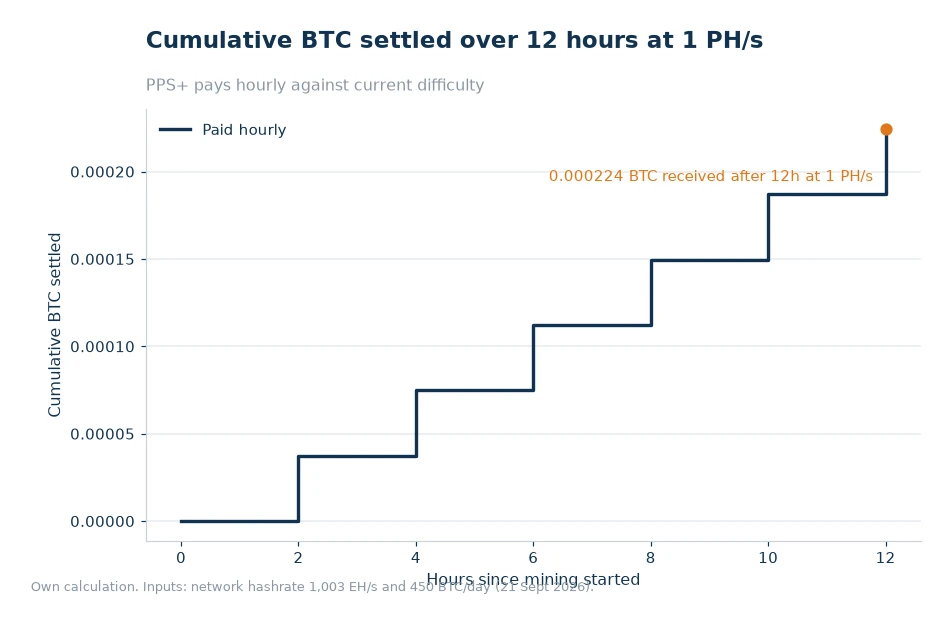
Switching pools is easy to do and hard to judge, because the first day feels either suspiciously good or suspiciously quiet. A short, fixed test window solves that. Run one petahash for twelve hours and the credits should land at 0.0002243 BTC, worth about $19.00 at $84,692 per BTC, with a step every hour. If the account shows something far from that, the problem is worth finding before the rest of the farm is moved.

Key takeaways
- Twelve hours at 1 PH/s should produce 0.0002243 BTC, or $19.00 at $84,692.
- Compare the total and the step count; a correct total with missing steps hides a reporting gap.
- Leave a small balance in the account through the test so the withdrawal path is exercised, not just the credit path.
- Judge the switch on credits per unit of hashrate, not on the dollar value of a single day.
What twelve hours can and cannot prove
Half a day is long enough to prove that shares are being accepted, that the account is credited, and that the settlement method matches what you signed up for. It is not long enough to prove anything about long-run returns, because a PPS+ credit depends on difficulty and difficulty barely moves inside twelve hours. That asymmetry is useful. You get a clean test of plumbing and no meaningful signal about profitability, which is exactly the split you want when validating a migration.
The test also catches the mistakes that are expensive at scale: a worker name pointed at the wrong coin, a hashrate figure reported in the wrong unit, a payout address pasted from an old wallet, or a fee tier applied to the wrong account. Each of those shows up as a mismatch between the expected curve and the observed one within a few hours, while the machine is still a single unit rather than a hall full of them.
The one number to carry into the comparison
Credits per petahash per hour is the portable metric. At the network conditions read on 21 Sept 2026 it works out to 0.00001869 BTC, derived from 450 BTC a day spread across about 1,003 EH/s. Every other figure in this article is that number multiplied by time. Carrying it into the comparison means you can test a 400 TH/s machine, a 2 PH/s group or a mixed rack without recalculating from scratch.
Do not carry the dollar figure instead. Nineteen dollars for half a day sounds trivial next to the capital cost of a petahash, and that reaction is how operators talk themselves out of a test that would have caught a real fault. The BTC number is the stable one; the dollar number moves with a price you did not choose. Confirm the rate applied to your account on the pricing page before the test, so the expectation matches the tier you are actually on.
Reading the first settlement steps
The curve for this test has seven plotted points and six visible steps, one every two hours on the axis. Between steps the line is flat because the credit is batched hourly and plotted at wider intervals. Expect the account itself to show twelve separate additions over the window, even though the chart compresses them.
Two patterns deserve attention. A curve that rises but sits consistently below expectation suggests the machine is hashing under its rated speed, or that a portion of shares is being rejected. A curve that matches in total but arrives in two large lumps rather than twelve small ones suggests the account is on a different settlement method than you assumed. Both are fixable, and both are much cheaper to fix during a trial.
Exercise the withdrawal path too
A credit that cannot leave the account is not really income. During the trial, withdraw the twelve-hour balance once, even though it is small. The point is to confirm the destination, the confirmation behaviour and the record-keeping before the amounts matter. On this platform mining payouts carry no fee, so the exercise costs nothing except a few minutes of attention.
The destination is the multi-currency wallet that shares the same login as the mining dashboard, and that is where the test becomes a two-part check. Credits should appear in the mining view, and the transferred coins should appear in the wallet view, with the same amount on both sides. A shortfall between the two is either a display lag or a real problem; either way you want to see it now. The ViaBTC Crypto Wallet also holds the coins you are not mining, which makes it a reasonable place to keep the trial balance while you decide whether the migration continues.
Failure signals that justify stopping the rollout
Three signals are strong enough to pause a farm-wide move. The first is a persistent gap of more than a few percent between expected and observed credits after the first two hours. The second is an hourly step that is missing entirely rather than merely late, since a missing step usually means a share-logging problem rather than a rounding issue. The third is a payout address or worker configuration that does not match what you recorded before the switch.
Everything else can wait for a longer observation period. Difficulty movement, pool luck on the other method and price swings all produce noise that looks like a signal inside twelve hours. Writing the three stop conditions down before the test starts is what keeps a routine check from turning into an argument about a bad afternoon.
| Checkpoint | Expected BTC | USD at $84,692 | If observed is 5% low |
|---|---|---|---|
| Hour 2 | 0.00003738 | $3.17 | Too early to act; note it |
| Hour 6 | 0.00011215 | $9.50 | Check rejected shares |
| Hour 10 | 0.00018692 | $15.83 | Confirm worker name and coin |
| Hour 12 | 0.0002243 | $19.00 | Hold the rollout, open a ticket |
Worked example
Build the expectation from the network first. The chain issued 450 BTC a day over 1,003 EH/s, giving 450 ÷ 1,003,000,000 = 0.00000044865 BTC per TH/s per day. At 1,000 TH/s the daily credit is 1,000 × 0.00000044865 = 0.00044861 BTC.
- Hourly rate: 0.00044861 ÷ 24 = 0.000018692 BTC.
- Two hours: 2 × 0.000018692 = 0.00003738 BTC, or $3.17.
- Six hours: 6 × 0.000018692 = 0.00011215 BTC, or $9.50.
- Ten hours: 10 × 0.000018692 = 0.00018692 BTC, or $15.83.
- Twelve hours: 12 × 0.000018692 = 0.00022430 BTC; at $84,692 that is $19.00.
- Fee check: the listed 4% applies to the PPS-settled block reward, so 0.0002243 × 0.04 = 0.00000897 BTC is the largest deduction that component can produce.
Now compare with the account. A result between roughly 0.000213 and 0.000235 BTC is inside normal reporting and rounding behaviour. A result near half that figure points at roughly half the hashrate being counted, which is a configuration problem rather than a pool problem.
Frequently asked questions
Is twelve hours enough to judge a new pool?
It is enough to verify plumbing and settlement, not returns. At 1 PH/s expect 0.0002243 BTC over the window, and treat any large deviation as a configuration issue to investigate.
Should the test run at full farm hashrate?
No. Move one machine or one small group first, so a misconfiguration affects a thousandth of your output rather than all of it.
What if the credits are correct but the steps are missing?
Ask support to check how shares are logged; a correct total with an incomplete series usually means a reporting delay rather than unpaid work.
Write the pass mark before the machine moves
The test is only an acceptance test if the pass mark exists in advance. Put three lines on paper: the expected half-day credit at your hashrate, the acceptable band around it, and the conditions that stop the rollout. At 1 PH/s the first line reads 0.0002243 BTC, the second reads plus or minus five percent, and the third covers missing steps and mismatched configuration.
Then let the machine run and look at the account twice, at hour six and hour twelve. Two looks are enough. A miner who refreshes the page every twenty minutes during a trial learns nothing extra and starts seeing patterns in rounding. If the numbers pass, move the next group and repeat the same check at a larger size; if they fail, you have lost half a day of one machine's output and gained a clear diagnosis. The pool state page is the natural place to see whether the wider pool is behaving normally at the same time, which separates your fault from a network-wide wobble.
Sources: ViaBTC fee and wallet documentation for settlement timing and the listed 4% on the PPS-settled block reward[1]. The pool credit is measured against a 21 Sept 2026 network reading of roughly 1.003 ZH/s, difficulty 132.76 T, 3.125 BTC per block, 144 blocks daily and BTC at $84,692. The write-up appeared on 24 Oct 2026, with its figures read 21 Sept 2026.